
Keywords: Armenia, Georgia, South Caucasus, Democratic Backsliding, EU Accession, State Capture.
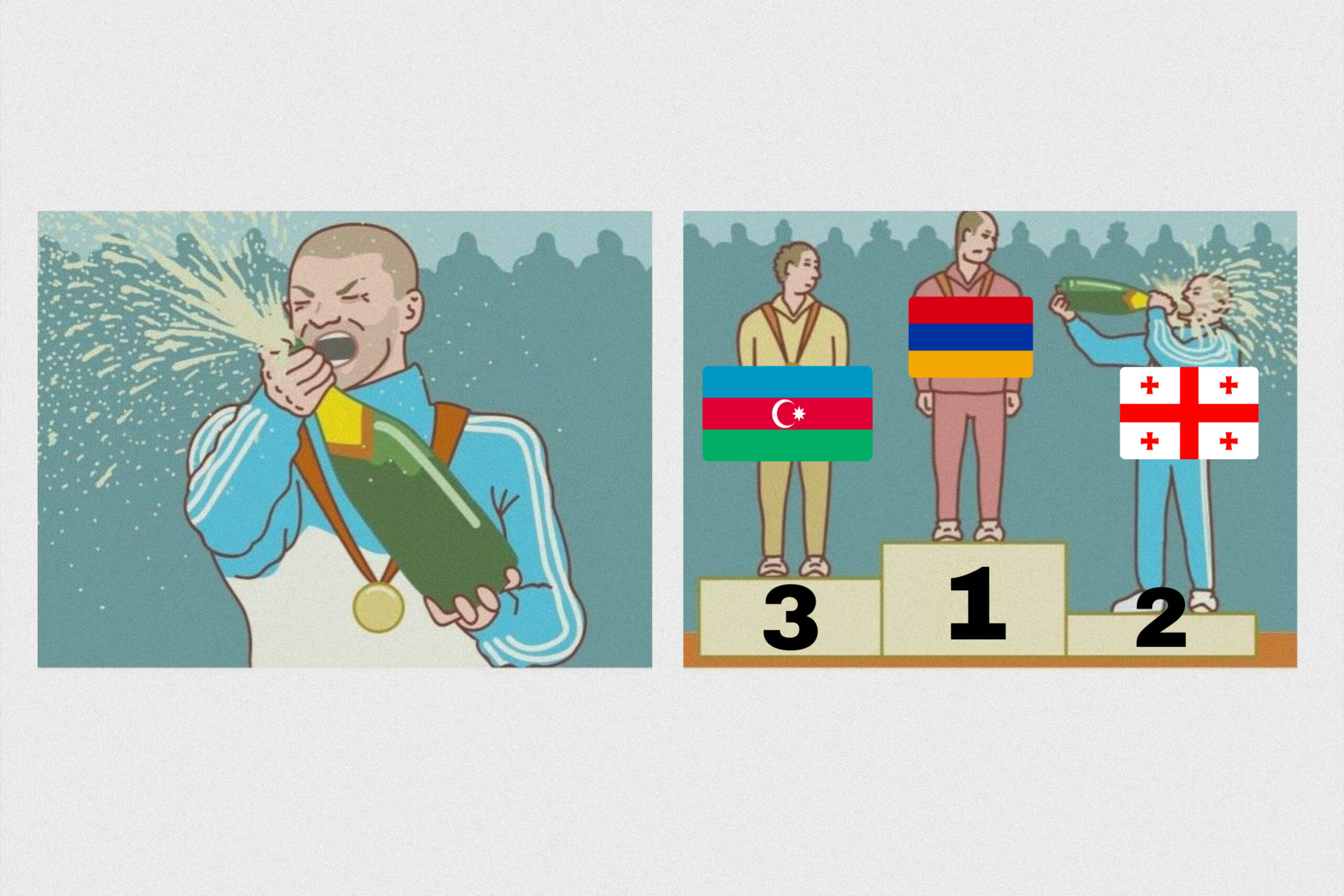
Georgia has been the democratic champion of the South Caucasus for more than a decade. Today, that hierarchy has flipped. Currently, Armenia has a score of 54/100 and Georgia 51/100 (Freedom House, 2026). This brief breaks down the mechanics behind this shift. The reason for Armenia’s lead is not a recent democratic movement, but rather the fact that it has been able to safeguard the fundamental principle of civic pluralism and the separation of big business from the state since 2018. In the meantime, Georgia’s downfall is directly due to the ruling party taking control of the country from top to bottom, and the EU has been frozen in its tracks.
You Might Aslo Read
The South Caucasian old geopolitical game theory is that the region can be divided into three neat boxes: an absolute autocracy in Azerbaijan, a fragile hybrid state in Armenia, and a reforming, pro-Western democracy in Georgia (Broers, 2020).
That playbook is out of date, and it’s time to move on. Armenia has jumped ahead of Georgia in the world’s rankings for freedom. The baseline scores of its neighbors have been reversed (Freedom House, 2026), while Azerbaijan is still completely unfree at 6/100. This short argues that the actual domestic causes for this change are quite different: how Armenia’s institutions survived strong security crises and how Georgia squandered its chance for democratic development and European integration.
The Numbers Behind the Realignment
The regional shift comes down to aggregate scores eroding on one side while holding firm on the other.
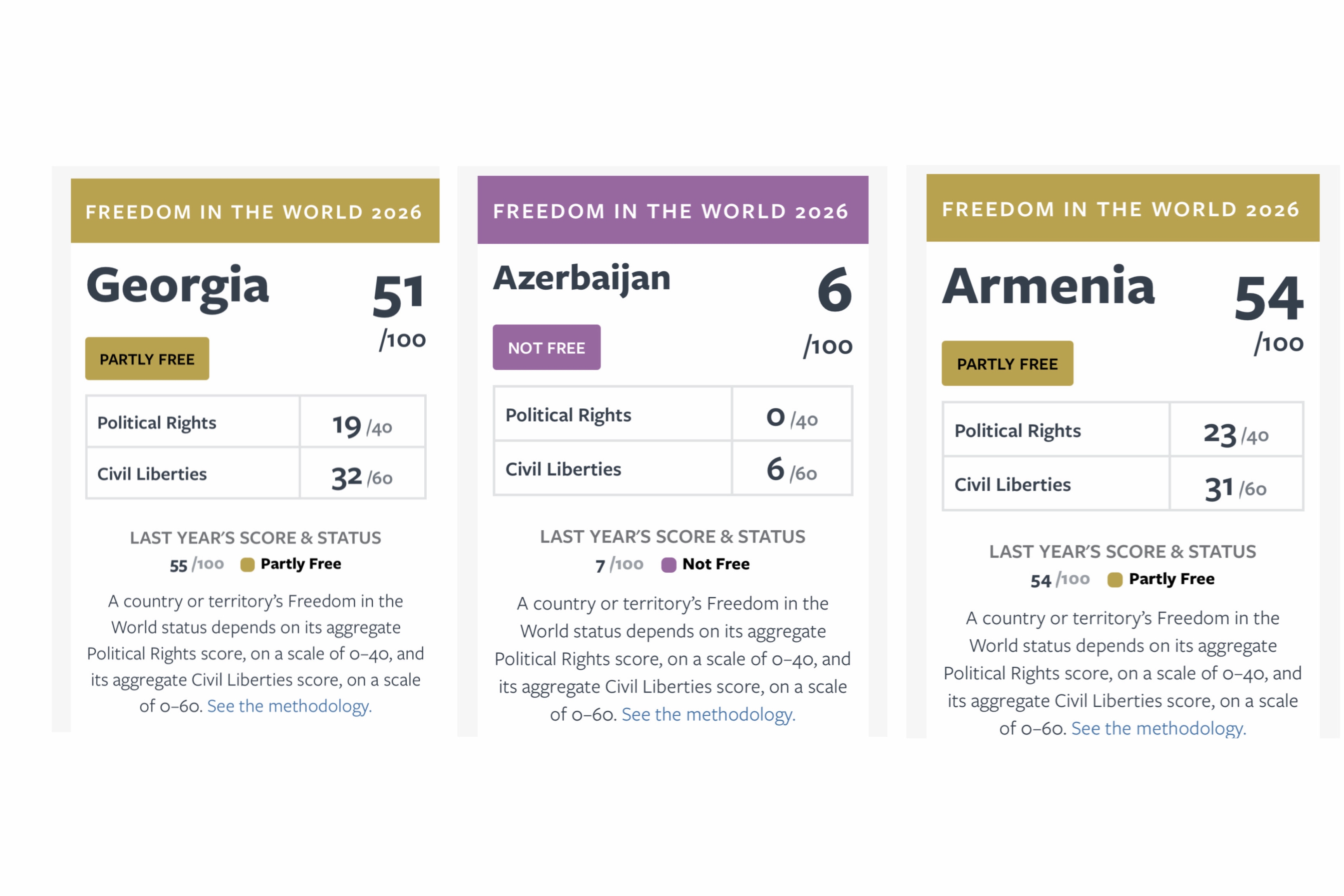
The data makes one thing clear: Armenia did not jump ahead through a massive democratic leap forward. Instead, Yerevan maintained its post-2018 baseline while Tbilisi went into a managed institutional tailspin.
How Armenia Maintained its Baseline Alive
In a surprising twist, Armenia’s lead comes despite the severe external shocks it has endured, such as a devastating war last year and a sudden surge of over 100,000 people displaced from Nagorno-Karabakh. In most fragile hybrid regimes, such crises culminate in an executive power grab or complete the breakdown of democracy. For three reasons, Armenia didn’t take that route:
- Before 2018, Armenia’s economy and government were managed by a closed oligarchic club (Gasparyan, 2023). These economic monopolies are effectively separated from the legislature by reforms after the revolution that clean up public procurement and allow anti-corruption watchdogs to function.
- The real test was in the snap 2021 parliamentary elections immediately following the crushing military loss. The elections were clean, highly competitive, and carried out without hindrances (Donabedian, 2022), despite the anger of the societies. Most importantly, everyone accepted the results, and the ballot box was the only means of wielding power.
- Decentralized Media Scene: Armenia’s online environment is disorderly, competitive, and “free.” An open media market is a good restraint on the executive branch, as there is no dominant state broadcaster that can dominate the narrative entirely.
The Reality Check: Armenia is far from perfect. There is still a risk of political pressure on the judiciary, and the government still heavily depends on long-term pre-trial detention of political opponents (Human Rights Watch, 2024). These are institutional shortcomings, however, and not a conscious, government-based effort to crush political opposition.
Inside Georgia’s Top-Down Slide
In contrast, Georgia’s democratic decline is an active, top-down strategy run by the ruling Georgian Dream (GD) party. This is intentional abuse of a state authority to eliminate political competition (Lebanidze & Kakachia, 2023). It operates via three main streams:
- In Georgia, the real power has been transferred from official government institutions into the hands of billionaire Bidzina Ivanishvili and his informal networks, a concept of shadow governance. This shadow control has allowed the ruling party to fill courts and change the rules for the Central Election Commission, which would have to include some multiparty avenues.
- Parliament has been systematically used by the government to stifle civic space, or what is known as the weaponization of the law, and the EU rupture. The adoption of the restrictive ‘foreign influence’ law was done with the clear intention of curtailing access to funding for independent NGOs and media watchdogs (Jones & Kakachia, 2024). This was a step that severed Georgia’s ties with the West. The European Council in Brussels finally suspended millions of dollars in military assistance for Georgia and froze its path to EU integration (European Council, 2025). In response, the government upped the ante, officially suspending EU accession talks until 2028 and making the country an EU “candidate” in name only.
- When the government suspended the EU negotiations, it sparked huge and sustained street protests known as “street violence and intimidation.” The state responded in a forceful manner. In addition to riot police, international monitors recorded coordinated attacks by plainclothes security personnel who physically attacked and beat opposition leaders, journalists, and activists outside their homes (Amnesty International, 2024).
Geopolitical Fallout
Democratic progress is a non-linear process. Georgia is a testament to the fact that achieving integration success, such as EU candidate status, doesn’t mean anything if the elite at home decide to seize control of the state. By contrast, Armenia demonstrates how a civic base can be established to withstand extreme national security crises by dismantling oligarchic monopolies.
The new political shift in Georgia has led to a tremendous change for the entire region. Georgia’s isolation directly impacts Armenia, which relies on Georgia for 80% of its trade routes to Europe. Western partners have to adjust rapidly: support for democratic institutions in Armenia should go straight to support its vulnerable institutions, and unambiguous, targeted financial and travel sanctions should be imposed against the Georgian political actors behind state capture.
References
Amnesty International. (2024). Georgia: Freedom of peaceful assembly under siege. Amnesty International Report. https://www.amnesty.org
Broers, L. (2020). Armenia and Azerbaijan: Anatomy of a rivalry. Edinburgh University Press.
Donabedian, A. (2022). Post-war elections and democratic resilience in Armenia. Journal of Caucasian Studies, 7(2), 145–168.
Eshment, B. (2021). The legacy of the Velvet Revolution: Post-revolutionary institutionalization in Yerevan. Central Asian Survey, 40(3), 312–329.
European Council. (2025). Conclusions on enlargement and the de facto halting of Georgia’s accession path. European Council Presidency Report.
Freedom House. (2025). Freedom in the world 2025: The democratic cost of regional backsliding. Freedom House. https://freedomhouse.org
Gasparyan, A. (2023). De-oligarchization and public procurement transparency in post-2018 Armenia. Caucasus Analytical Digest, 134, 3–9.
Human Rights Watch. (2024). World report 2024: Events of 2023. Human Rights Watch. https://www.hrw.org
International Crisis Group. (2026). Managing Georgia’s turn against the EU. Watch List 2026 – Spring Edition. https://www.crisisgroup.org
Jones, S., & Kakachia, K. (2024). The polarization of Georgia: Oligarchic capture and the erosion of the third wave. Routledge.
Lebanidze, B., & Kakachia, K. (2023). Informal governance and democratic backsliding in the EU’s neighborhood: The case of Georgia. European Foreign Affairs Review, 28(1), 45–66.