
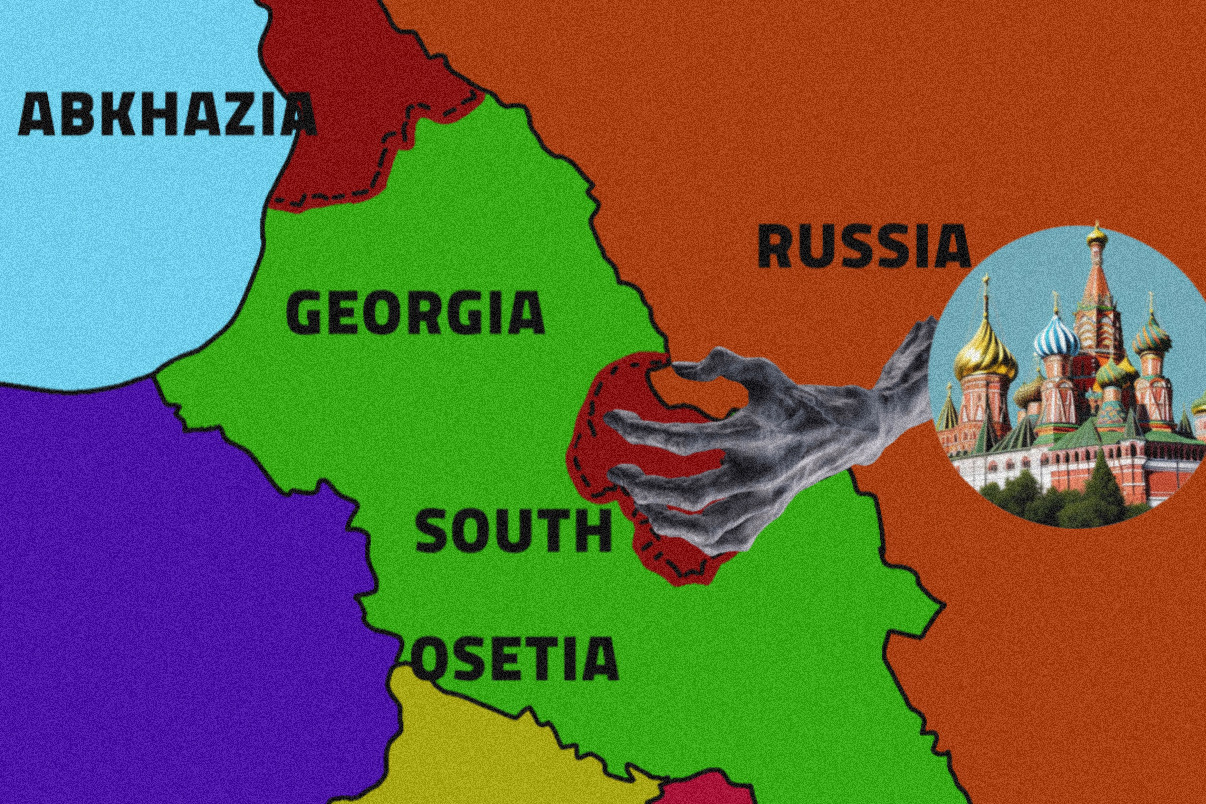
Moscow has been following two obviously divergent policies regarding its control of the two breakaway territories of Georgia since May 2026. In South Ossetia, the Kremlin has taken the legal and institutional route, communicating directly with Russian officials in the region. In Abkhazia, where the same strategy led to popular uprisings, Moscow has focused on building physical infrastructure: ports, airports, and railways that it can gradually move into the country’s economic and military sphere. Both tracks are headed by the Kremlin’s longtime domestic policy manager Sergei Kiriyenko, who is also responsible for Russia’s occupied Ukrainian territories, and both are aimed at the same goal: the gradual abandonment of the territories’ distinctiveness, though not by issuing an annexation decree.
South Ossetia: Absorption Through Law
On 9 May 2026, at the Kremlin, Vladimir Putin signed a “Treaty on Deepening Allied Cooperation” with de facto South Ossetia President Alan Gagloev, orchestrating the timing of the act to coincide with Victory Day, 2026 (bne IntelliNews, 2026). It was ratified by Russia’s State Duma in a matter of days, signed into law by Putin on May 25 (TASS, 2026). The paper is more than the previous alliance pacts from 2008 and 2015. For the first time, Russian citizens are allowed to hold state and municipal offices within South Ossetia’s government, while the two sides agreed to align their civil and tax legislation and will cooperate to ensure the protection of property rights, in other words, Russian nationals will have the same rights to buy and hold land as local citizens (Jamestown Foundation, 2026, May 28). A gradual unification will take place in energy, transport, telecommunications, and pension systems.
Gagloev’s comments reflect his previous ones about eventual accession to the Russian Federation, when he described the treaty as “a step towards the reunification of the Ossetian people” (JAMnews, 2026). The institutional implications were not far behind. In June 2026, Gagloev resigned after being appointed an adviser to Putin, and Marat Kambolov, a career Russian federal official from North Ossetia with no prior South Ossetian government experience, was named prime minister and, by succession, acting president (Jamestown Foundation, 2026, June 27). This is the clearest proof of the fact that now Moscow can put its own people at the helm of the government in Tskhinvali without the international community intervening with the consequences that a formal annexation would cause, analysts say (Georgia Today, 2026).
Abkhazia: From Resistance to Infrastructure
First, Moscow has attempted such a tactic in Abkhazia, and it failed. In 2024, Russian and Abkhaz authorities negotiated a deal that would have allowed the Russian people and businesses to purchase and build in Abkhazia, including an “apartment law” that was part of the agreement. This was perceived as a demographic threat by the Abkhaz civil society as a whole to a territory of around 245,000 people, and in November 2024 thousands of protesters stormed the parliament and the presidential administration in Sokhumi, forcing the resignation of President Aslan Bzhania (Euronews, 2024). The investment agreement was later formally revoked by the Parliament of Abkhazia weeks later. The Abkhazian elites have always strived to protect their autonomy, and in May 2026, after the signing of the South Ossetia treaty, Abkhazia’s parliament went in the opposite direction, imposing a five-year residency requirement on anyone seeking to hold local office and prohibiting foreigners from participating in Abkhaz politics altogether (Castillo, 2026).
Responding to this opposition, Kiriyenko, personally assigned as a watchdog over Abkhazia in early 2025 and a native of Sokhumi, changed his stance from pro-legal change to supporting his preferred candidate, Badra Gunba, in the subsequent snap presidential election in February of 2025, following the resignation of Bzhania (Carnegie Endowment for International Peace, 2025). A pro-Moscow leadership was now being installed, and their strategy shifted to non-parliamentary transferable interests: infrastructure. Russia has been going ahead with the construction of the Ochamchire naval base on the Black Sea coast of Abkhazia, which the Russian Black Sea Fleet used as a staging point during the 2008 conflict and which has been under active expansion since 2022–2024, with new berths, buildings, and rail links added despite the shallow nine-meter harbor. Together, in 2026, Gunba and Kiriyenko opened the first Russian-financed commercial airport in Abkhazia since Soviet times, and Gunba has publicly promoted the Ochamchire port and new Russian rail connections as engines of economic development (Castillo, 2026). Where land sales provoked mass protest, port construction and runway pavement have not, even though the strategic effect, binding Sokhumi’s economy and security architecture to Moscow, is arguably deeper and harder to reverse.
Tbilisi’s Dilemma
These events have come at an inopportune time for Georgia’s government. The ruling Georgian Dream party has been walking a patient path vis-à-vis the Russian Federation, with the expectation that “gentle” conduct will help to thaw the Russian stance towards the occupied territories. The May 2026 treaty almost immediately undercut that patient approach: Foreign Minister Maka Botchorishvili condemned the South Ossetia accord as further evidence of Russia’s annexation plans, though her statement came six days after the treaty was signed (Castillo, 2026). Its opposition leaders, including former Prime Minister Giorgi Gakharia, have been much more straightforward; the treaty is the establishment of direct Moscow rule over occupied Georgian territory (Castillo, 2026).
This is not a new vocabulary. The term “creeping annexation” has been applied to Russian activities in the areas under its control since at least the early 2010s, when Georgian officials and commentators first reported on the “borderization” of its border regions and the ‘alliance treaties’ signed in 2014-2015, in which Abkhaz and South Ossetian security structures were incorporated into the Russian system. The difference in the present is that the two territories, South Ossetia and Abkhazia, are being absorbed in different ways – “through statute” and “concrete and steel.” Both paths pave the way for the opposition in Tbilisi to the same destination, and both expose the limits of a government strategy premised on the hope that avoiding confrontation with Moscow would be rewarded with restraint.
References
bne IntelliNews. (2026, May 22). Caucasus blog: Russia’s South Ossetia treaty edges toward annexation. https://www.intellinews.com/caucasus-blog-russia-s-south-ossetia-treaty-edges-toward-annexation-444313/
Carnegie Endowment for International Peace. (2025, February). Moscow has run out of patience in Abkhazia. https://carnegieendowment.org/russia-eurasia/politika/2025/02/russia-abkhazia-new-pressure?lang=en
Castillo, N. (2026, June 12). Some Georgians think Russia just annexed part of their country. The Moscow Times. https://www.themoscowtimes.com/2026/06/12/some-georgians-think-russia-just-annexed-part-of-their-country-a93004
Euronews. (2024, November 15). Protests erupt in Abkhazia over pro-Moscow property measure. https://www.euronews.com/2024/11/15/protests-erupt-in-abkhazia-over-pro-moscow-property-measure
Georgia Today. (2026, May 14). The illusion is officially dead. https://georgiatoday.ge/the-illusion-is-officially-dead/
Jamestown Foundation. (2026, May 28). Moscow makes a new step for annexation of Georgian territories. https://jamestown.org/moscow-makes-a-new-step-for-annexation-of-georgian-territories/
Jamestown Foundation. (2026, June 27). South Ossetia and Russia make further steps toward annexation. https://jamestown.org/south-ossetia-and-russia-make-further-steps-toward-annexation/
JAMnews. (2026, May 11). ‘De facto annexation’: Russia and South Ossetia sign new alliance agreement. https://jam-news.net/de-facto-annexation-russia-and-south-ossetia-sign-new-alliance-agreement/
TASS. (2026, May 25). Russia ratifies treaty on closer cooperation with South Ossetia. https://tass.com/politics/2136345