
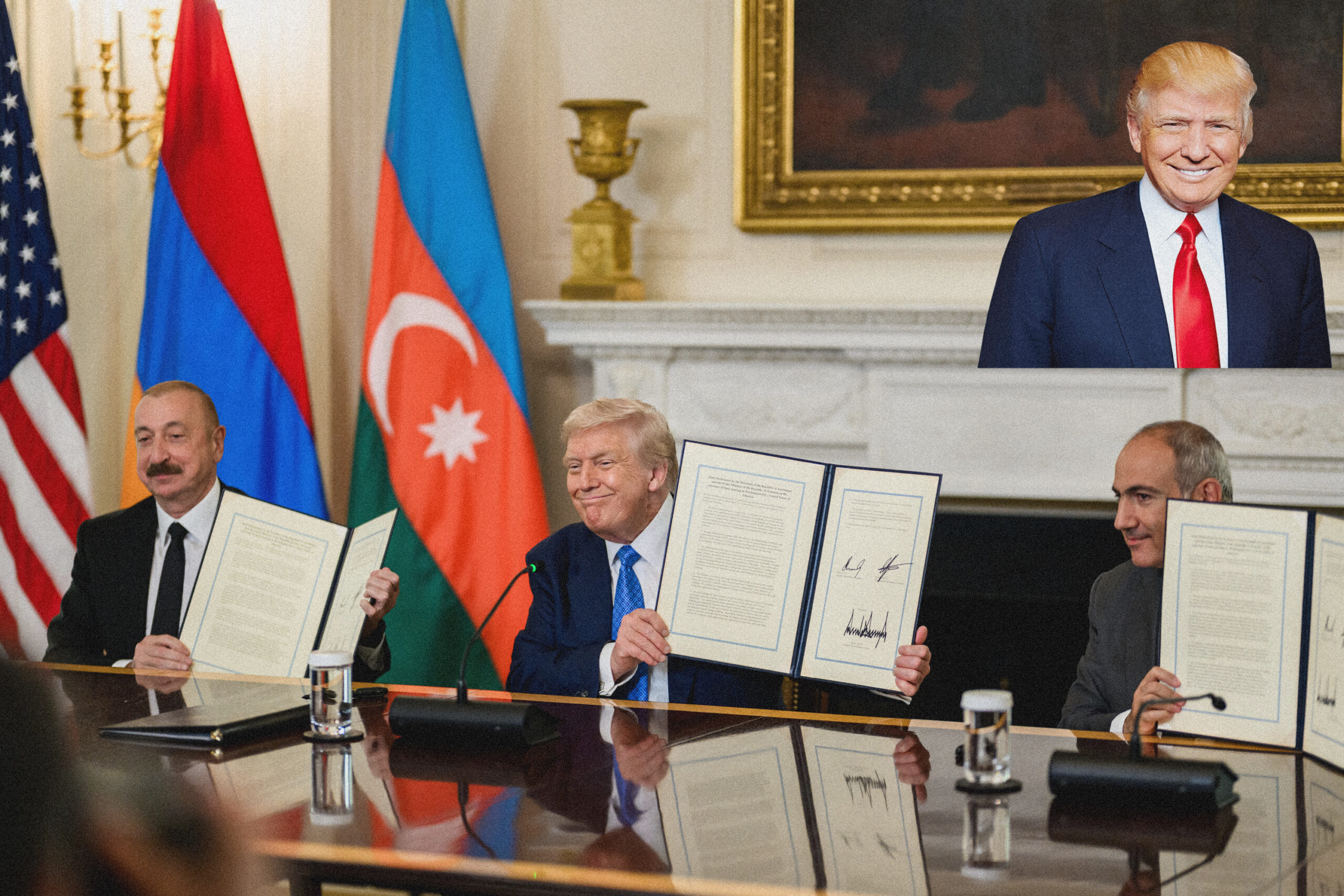
On August 10, 2026, the U.S. Department of State issued a joint statement commemorating the first anniversary of President Aliyev and Prime Minister Pashinyan’s signing of a Joint Declaration for Peace at the White House summit that took place one year ago. In the anniversary statement, President Aliyev and Prime Minister Pashinyan jointly nominated President Trump for the Nobel Peace Prize; separately, Trump spoke by phone with each leader around the anniversary (Breitbart, 2026). All three capitals sounded joyous. On further investigation, it is a blend of real progress, measurable progress, and promises that are still more wishful than fulfilled.
Trade and Transit: Real Numbers, Modest Scale
The most tangible development in the last year has been Azerbaijan’s unilateral removal of restrictions on Armenia’s transit through the country since the early 1990s. In the last year, close to 60,000 tons of goods have been moved to and from Armenia through Azerbaijani territory, and Azerbaijan has provided Armenia with 20,000 tons of oil products. For the first time, Baku sells fuel directly to Yerevan (U.S. Department of State, 2026). The figures were confirmed by the Foreign Ministry of Armenia in its statement (Local Glob, 2026).
A different, and in some measures also more revolutionary, development was realized in June 2026, with the two main telecom operators in each of the countries (AzerTelecom and Telecom Armenia) signing bilateral contracts to transport international Internet traffic via their networks (CIVILNET, 2026a). It is noteworthy that this deal has been negotiated by private enterprises and, in part, serves Azerbaijan’s own interest by enabling the Azerbaijani territory to be linked with the mainland by passing through the territory of Armenia, for which Baku is paying Yerevan on commercial terms (CIVILNET, 2026a; commonspace.eu, 2026). It’s a way of doing business, and it’s not an easy thing to do: both sides have something valuable to offer.
TRIPP: Progress on Paper, Not Yet on the Ground
The main element of the peace accord is the Trump Route for International Peace and Prosperity (TRIPP), a proposed 42-kilometer multimodal route to be built on a 99-year development lease by an operator from the U.S., which would connect mainland Azerbaijan with the Nakhchivan region of the country (Caspian News, 2026). Washington and Yerevan have agreed to establish the TRIPP Development Company to spearhead infrastructure development, and engineering surveys are now underway within Armenia (U.S. Department of State, 2026).
President Aliyev, on the Azerbaijani side, has said the Horadiz-Aghband highway to the Armenian border is “practically ready,” but the parallel railway will reach the border only in 2027 (Horizon Weekly, 2026). The language of this joint statement is more measured than that of the “completed” framing often seen in secondary reporting: Azerbaijan has “nearly completed” its side of the highway and railroad (U.S. Department of State, 2026). Independent analysis has been more pointed. Nine months into the project, according to a May 2026 Civilnet assessment, “not a single meter of construction” has been made on Armenian soil, and a peace treaty, a finalized contract with the operating company, and a resolution of an unresolved Russian railway concession in the same corridor are yet to be signed (Civilnet, 2026b). An analysis by the Carnegie Endowment for International Peace also warned that the peace process is still in its infancy and that the public is not keeping up to date with it, significantly in both countries (Carnegie Endowment for International Peace, 2026).
The Minsk Group: An Old Decision, Repackaged
The joint statement also acknowledges the contribution of Armenia and Azerbaijan’s joint request to dismantle the OSCE Minsk Group and its associated structures as part of the year’s success (U.S. Department of State, 2026). This is correct but can be interpreted as a new development on the anniversary. In fact, on August 8, 2025, on the day of the summit in Washington, the Yerevan-Baku joint application to dismantle the Minsk Group was submitted, which was unanimously approved by the OSCE Ministerial Council on September 1, 2025 (The Armenian Report, 2025; CIVILNET, 2025), and drop the CIVILNET citation from this specific claim and attribute the November 30 completion date to The Armenian Report (2025) alone. When the statement is made in August 2026, by the time this statement is issued in August 2026, both the decision and its execution had already taken place roughly a year earlier, this is not a new decision.
The end of the dissolution marked the end of the only forum that had been established internationally for over 30 years to discuss the conflict in Nagorno-Karabakh, and that was a contentious one. Representatives of the roughly 150,000 Nagorno-Karabakh Armenians displaced after Azerbaijan’s 2023 takeover of the region had appealed to OSCE states to preserve the Minsk Group, arguing that its closure eliminated one of the few remaining international frameworks that had ever formally acknowledged their situation as an open question (OC Media, 2025).
Other Elements of the Statement
The joint statement also mentions that Armenia and Azerbaijan have become members of the “Board of Peace” at the invitation of the United States and that the United States has signed bilateral strategic-partnership charters and memoranda of understanding with each of them on energy security, border infrastructure, artificial intelligence and semiconductors, and critical minerals (U.S. Department of State, 2026). Rubio separately announced that the $201 million Trans-Caspian Enterprise Fund to facilitate private investment in the broader Middle Corridor region has been launched (Breitbart, 2026).
Assessing the Year
The anniversary statement charts a peace process that so far has generated real freight tonnage, real fuel shipments, a real (but not necessarily ideal) telecoms deal, and a signature infrastructure project that is still significantly under-constructed, while a peace treaty remains initialed but not signed, one year later. For example, the timing of the Minsk Group’s dissolution as a new achievement, while it actually started more than a year ago in reality, shows a general style in how the year is packaged in the anniversary statement: creating a single celebration out of a series of new and old events. For a peace process still missing a signed treaty and unbuilt infrastructure on one side of its central corridor, that narrative is likely to keep outpacing the facts on the ground for some time yet.
References
Breitbart. (2026, August 9). One year later, President Aliyev credits Trump for historic Armenia peace. https://www.breitbart.com/politics/2026/08/09/azerbaijans-pres-aliyev-marks-one-year-of-trump-brokered-armenia-peace-says-u-s-ties-at-highest-point-in-34-years/
Carnegie Endowment for International Peace. (2026, April 1). Rewiring the South Caucasus: TRIPP and the new geopolitics of connectivity. https://carnegieendowment.org/research/2026/03/rewiring-the-south-caucasus-tripp-and-the-new-geopolitics-of-connectivity
Caspian News. (2026, June 1). Zangezur Corridor set to become reality, President Aliyev says. https://caspiannews.com/news-detail/zangezur-corridor-set-to-become-reality-president-aliyev-says-2026-6-1-35/
CIVILNET. (2025, September 1). Minsk Group dissolved as “diplomacy triumphs” following ethnic cleansing. https://www.civilnet.am/en/news/972171/minsk-group-dissolved-as-diplomacy-triumphs-following-ethnic-cleansing/
CIVILNET. (2026a, June 23). Armenian and Azerbaijani telecom operators sign internet transit deal. https://civilnet.am/en/news/1012664
CIVILNET. (2026b, May 16). The fragile geopolitics behind the TRIPP corridor. https://civilnet.am/en/news/1011872
commonspace.eu. (2026, June 23). Azerbaijan-Armenia internet transit deal marks new step in regional connectivity. https://www.commonspace.eu/news/azerbaijan-armenia-internet-transit-deal-marks-new-step-regional-connectivity
Horizon Weekly. (2026, August 10). Aliyev says railway to Armenia border will be completed next year. https://horizonweekly.ca/en/aliyev-says-railway-to-armenia-border-will-be-completed-next-year/
Local Glob. (2026, August 10). Armenia imports 20,000 tonnes of oil products from Azerbaijan over past year — MFA. https://www.localglob.com/2026/08/armenia-imports-20000-tonnes-of-oil.html
OC Media. (2025, October 10). OSCE dissolves Minsk Group. https://oc-media.org/osce-dissolves-minsk-group/
The Armenian Report. (2025, December 1). OSCE officially dissolves Minsk Group after 30 years of Artsakh mediation. https://www.thearmenianreport.com/post/osce-officially-dissolves-minsk-group-after-30-years-of-artsakh-mediation
U.S. Department of State. (2026, August 10). Joint statement of the United States of America, the Republic of Armenia, and the Republic of Azerbaijan on the one-year anniversary of the White House Peace Summit. https://www.state.gov/releases/office-of-the-spokesperson/2026/08/joint-statement-of-the-united-states-of-america-the-republic-of-armenia-and-the-republic-of-azerbaijanon-the-one-year-anniversary-of-the-white-house-peace-summit