
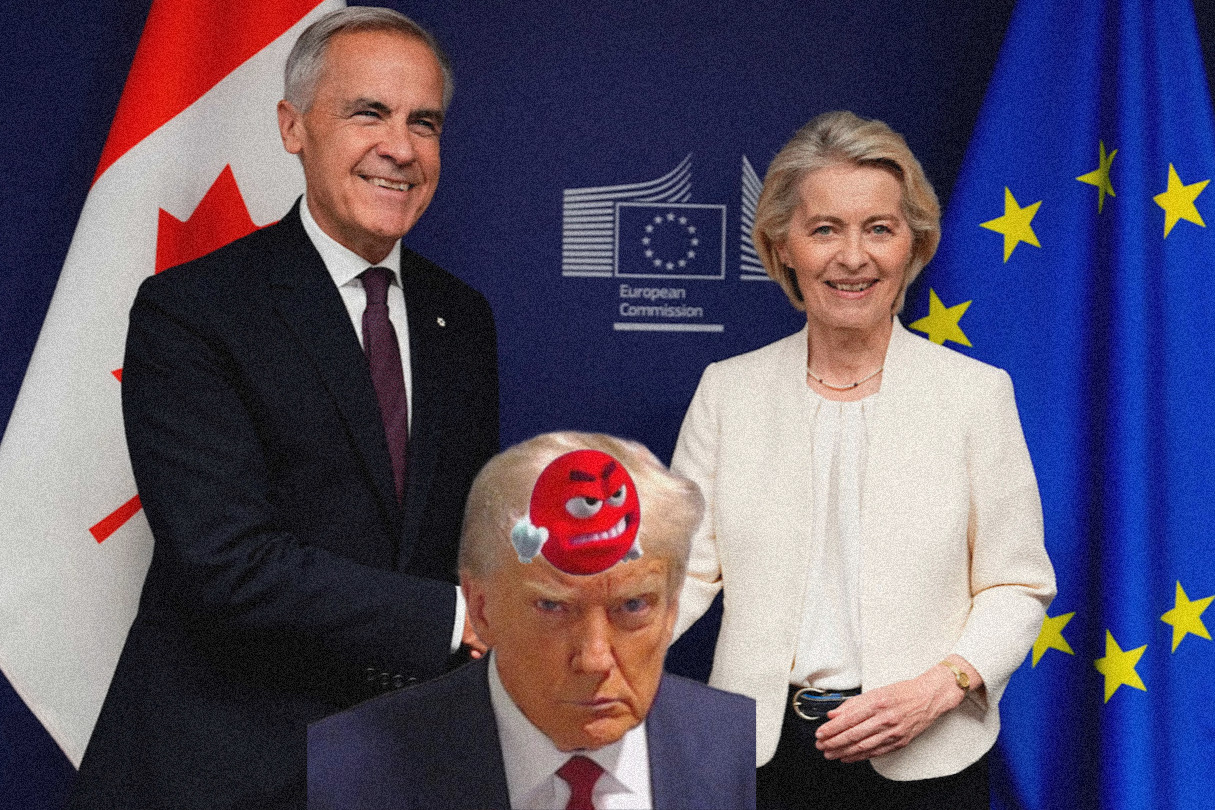
The President of the European Commission, Ursula von der Leyen, invited Canada to become the EU’s first “associate member,” with Prime Minister Mark Carney as her guest of honor during her annual State of the Union speech in Strasbourg on September 16, 2026 (NPR, 2026; Euronews, 2026a). The chamber applauded, and von der Leyen and Carney got the kind of hug that is reserved for old allies (NPR, 2026). But look closely at the celebration, and there is nothing to celebrate just yet: no one, including the Commission itself, has said what “associate membership” might entail.
The Announcement: A Standing Ovation, Not a Blueprint
Von der Leyen told Carney that Europe and Canada shared a belief that power belongs to everyone, not just “the strongest, richest, and loudest” (NPR, 2026), and proposed a parallel alliance covering technology, critical raw materials, energy, and defense (Euronews, 2026a). But the status itself does not currently exist anywhere in EU law, and the Commission has not clarified whether Canada would gain any voting rights in EU institutions (Euronews, 2026a; NPR, 2026). An EU spokesperson described the goal only in the vaguest terms, as building “the closest imaginable form of association with a partner outside Europe” (Axios, 2026), language that signals ambition rather than a plan. President Trump’s reaction was immediate and blunt: he called the idea “laughable” and warned that if he judged it a hostile act, he would respond with steep tariffs or halt trade with Europe altogether (NPR, 2026).
What’s Already There: CETA, Defense, and a Fund Called SAFE
The claim that this is a breakthrough conceals the fact that much of the Canada-EU relationship already exists. The Comprehensive Economic and Trade Agreement (CETA) has been in effect since 2017, in a provisional format, and has already removed tariffs on almost all traded goods between the two sides (CNBC, 2026). In 2025, they signed a security and defense cooperation agreement, and this year Canada became the only non-EU country granted access to the fund, SAFE (NPR, 2026). Ten EU member states have yet to ratify CETA, more than 10 years after its signing (CP24, 2026). An obvious question arises: what does an undefined “associate membership” really contribute if a relatively small trade deal is not ratified in a third of the EU?
Not the First Use of the Term: The Ukraine Precedent
Canada is not even the first case this year in which “associate membership” was floated. In May 2026, German Chancellor Friedrich Merz proposed the same label for Ukraine as a step toward eventual full accession, allowing Ukrainian officials to sit in on EU summits and ministerial meetings without a vote and to have an associate judge at the European Court of Justice (Reuters via The Star, 2026; UATV English, 2026). Merz was explicit that the point was to speed Ukraine toward membership it was already formally seeking (Reuters via The Star, 2026).
Canada’s version inverts that logic entirely. Merz’s proposal targeted a country at war, already a candidate, pursuing accession. Carney’s targets a G7 economy with no accession ambitions, using membership language mainly as leverage in a trade dispute with Washington. That the EU is willing to stretch the same undefined term to cover both cases suggests enlargement policy is being improvised sector by sector rather than applied from a fixed rulebook.
Georgia’s Frozen Path: A Different Kind of Waiting Room
The contrast is even greater when compared with the experience of Georgia. In December 2023, Georgia was granted EU candidate status, but the European Council in June 2024 declared the EU accession process “de facto halted” following Tbilisi’s adoption of the “foreign influence” legislation and its crackdown on street protests (EEAS, 2026). The process was still in a temporary standstill as of the Council’s conclusions in December 2025, and Brussels has withheld more than €121 million in direct financial support and part of Georgia’s visa facilitation system (EEAS, 2026).
A country with formally recognized candidate status and years of preparation can continue to languish over governance issues, while a non-European, non-candidate nation is given a new favored status in a matter of days after a diplomatic gesture. But that’s not, all on its own, proof that Georgia’s suspension is incorrect, the EU has made it clear which reforms it is seeking to have reversed (EEAS, 2026), but there is evidence that Brussels’ enlargement and partnership tools run as much on political usefulness as on the ‘merit-based’ criteria the EU claims to apply.
Reasons for Caution
Beyond Washington’s objections, the proposal faces friction closer to home. Any new arrangement will need unanimous approval from all 27 member states, and reports suggest several capitals were irritated at not being consulted before von der Leyen’s announcement (NPR, 2026). In Canada, opposition politicians have already begun asking what Ottawa might be expected to give up in exchange for a status Carney insists is not full membership (NPR, 2026). Writing in the Globe and Mail the same day, columnist Doug Saunders was more direct still, arguing that whatever “associate membership” ends up meaning, it is unlikely to improve materially on ties Canada and the EU already had (The Globe and Mail, 2026).
Assessing the Proposal
A year from now, this may read as confirmation that new trade and defense ties had been developing between Canada and Europe since 2017. Or it could be a label without a body, something created in a single speech and silently dropped once the unanimity requirement and reaction of the U.S. kicked in. So far, it’s just a name, a standing ovation, and a commitment to discuss the details later, not yet a new way of European integration.
References
Axios. (2026, September 16). EU floats associate membership for Canada amid Trump trade tensions. https://www.axios.com/2026/09/16/eu-canada-associate-membership-carney-trump
CNBC. (2026, September 16). Canada invited to become EU’s first ‘associate member’ as Trump trade war intensifies. https://www.cnbc.com/2026/09/16/canada-eu-associate-member-von-der-leyen.html
CP24. (2026, September 13). Carney pushes idea of making Canada ‘associate member’ of EU, WSJ reports. https://www.cp24.com/news/canada/2026/09/13/carney-pushes-idea-of-making-canada-associate-member-of-eu-wsj-reports/
EEAS (European Union External Action Service). (2026). EU-Georgia relations [policy overview page]. https://www.eeas.europa.eu/node/400182_ab
Euronews. (2026a, September 16). Canada invited to become first ‘associate member’ of the EU. https://www.euronews.com/my-europe/2026/09/16/canada-to-become-first-associate-member-of-the-eu
Euronews. (2026b, September 13). Canada eyes ‘associate member’ status with EU amid US tensions, WSJ reports. https://www.euronews.com/2026/09/13/canada-eyes-associate-member-status-with-eu-amid-us-tensions-wsj-reports
NPR. (2026, September 16). EU offers Canada ‘associate member’ role; Trump calls it ‘laughable.’ https://www.npr.org/2026/09/16/nx-s1-5971043/eu-canada-carney-tariffs-trump
Newsweek. (2026, September 14). Trump trade war, ’51st state’ talk push Canada toward EU associate membership. https://www.newsweek.com/trump-trade-war-51st-state-talk-push-canada-toward-eu-associate-membership-12436634
Reuters via The Star. (2026, May 21). Germany’s Merz pitches ‘associate’ EU membership for Ukraine. https://www.thestar.com.my/news/world/2026/05/21/germany039s-merz-pitches-039associate039-eu-membership-for-ukraine
The Globe and Mail. (2026, September 16). Saunders, D. If Canada joins the European Union show, it will only be from the upper balcony. https://www.theglobeandmail.com/opinion/article-canada-carney-european-union-associate-membership/
UATV English. (2026, May 21). Merz proposes associate EU membership model for Ukraine ahead of full accession. https://uatv.ua/en/merz-proposes-associate-eu-membership-model-for-ukraine-ahead-of-full-accession/