
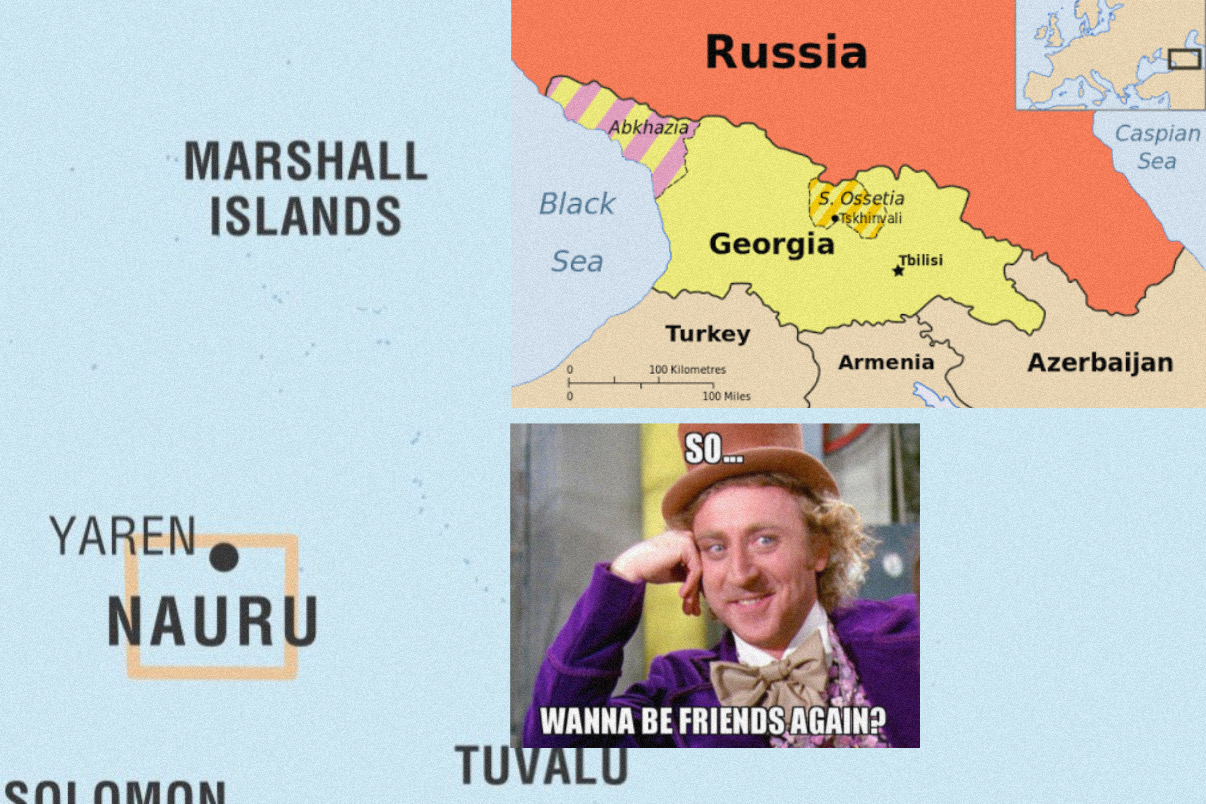
On July 21, 2026, the cabinet of Nauru, a phosphate-mining island nation of about 12,000 people in the South Pacific, made a decision that took more than a week to become public and even longer to be acknowledged by Nauru itself. It voted to terminate diplomatic relations with Abkhazia and South Ossetia, the two Georgian regions that have functioned as Russian-backed breakaway states since the 2008 Russo-Georgian War. The move was officially announced by Georgia’s Ministry of Foreign Affairs on July 29, with the de facto Foreign Ministry of Sokhumi confirming it indirectly the next day, attributing Nauru’s reversal to what it called ‘unprecedented and systematic external pressure’ (Georgia Today 2026b). Nauru’s government, notably, has said nothing at all.
It is a very small episode but symbolic. It shrinks, once again, the short list of United Nations member states willing to treat Abkhazia and South Ossetia as sovereign countries rather than as occupied Georgian territory.
A Recognition Born of the 2008 War
On August 26th, 2008, days after the Russian war with Georgia, Russia declared independence for Abkhazia and South Ossetia and urged allies and clients to do the same. It took Nicaragua and Venezuela less than a month. Nauru joined later and more pragmatically: in December 2009, its minister of Foreign Affairs at the time, Kieren Keke, signed the joint statements in Sokhumi which recognized both territories, and Nauru is the fourth UN member state to do so (AbkhazWorld, 2026). At the time, the Russian newspaper Kommersant reported that the island of Nauru had asked for approximately $50 million from Moscow, which was widely interpreted as a price for more or less recognition, though Abkhazia’s then-foreign minister, Sergei Shamba, publicly rejected the idea that recognition had been purchased outright (AbkhazWorld, 2026).
But Nauru was never left unguarded for long, nor was it always reliable. Vanuatu has previously recognized Abkhazia but changed its stance multiple times. In 2018, Syria became the next member of the small club and was led by Bashar al-Assad, which led to condemnations from the European Union that it violates Georgia’s territorial integrity (GlobalSecurity.org, 2018). Since Assad’s fall at the start of December 2024, the situation in Syria has been uncertain: the transitional authorities of Damascus have not revealed their plans for the future, and Lithuania has officially urged Damascus to reconsider the recognition (AbkhazWorld, 2026).
So, Nauru’s withdrawal leaves, at most, three member states of the UN, namely Nicaragua, Venezuela, and possibly Syria, still formally recognizing the two territories (Newdosh Media, 2026). The exact current number is not clearly known, but the fluidity and lack of institutionalization of this recognition regime have always been that.
Georgia’s Framing: A Diplomatic Victory
Tbilisi wasted no time claiming credit. Foreign Minister Maka Botchorishvili described the decision as “a highly significant victory for Georgia’s non-recognition policy,” crediting “diplomatic efforts deployed by our foreign service” and thanking individual diplomats for what she called years of work behind the scenes (1TV, 2026). In a public declaration, her ministry voiced similar sentiments, stating that the move ‘confirms Nauru’s respect for international law’ and expressing readiness to establish diplomatic relations with Nauru (Civil Georgia, 2026).
That fits a longstanding Georgian diplomatic pattern: rather than contesting the regions’ status through direct negotiation with their de facto authorities, Tbilisi lobbies third countries, often small, aid-dependent states with limited capacity to withstand pressure, to abandon recognition one at a time. Vanuatu’s and Tuvalu’s earlier victories have come by similar stealth diplomacy that offers incentives and calls on international law. But that pattern is continuing, and Nauru is no exception.
One of many structural factors is a U.S. legislative decision from 2017, signed during Donald Trump’s first term, prohibiting U.S. financial support for any government that recognizes Abkhazia or South Ossetia and establishes relations with them independently of Georgia (Georgia Today, 2026b). For a state like Nauru, heavily dependent on foreign aid and revenue from a declining phosphate industry, that law turns a largely symbolic diplomatic gesture into a recurring financial cost, one that grows harder to justify each year.
Sokhumi’s Counter-Narrative
Abkhazia’s de facto authorities have not accepted Tbilisi’s framing. Their Foreign Ministry statement characterized Nauru’s reversal as coerced rather than principled, describing a campaign of “political and diplomatic influence, as well as economic restrictions,” allegedly directed against Nauru once bilateral cooperation began moving from statements into practical joint projects (Nashaniva, 2026). The ministry’s broader argument that small, resource-constrained states are structurally the most vulnerable to this kind of pressure is a claim clearly meant to preempt further defections among the handful of states still on Abkhazia’s side, while also implicitly conceding that its recognition regime rests on a narrow and fragile base.
Why This Still Matters
The recognition was not, and has never been, sufficient to provide any real international legitimacy to Abkhazia and South Ossetia, and the overwhelming majority of UN member states still consider them to be part of the territory of Georgia under Russian occupation, a position shared by the European Court of Human Rights. Every step of the withdrawal removes one reason for Moscow to claim international approval for the recognitions, at least for any formal purposes, and gives Georgian diplomacy a cheap, alluring success at a time when there are few other ways to challenge the occupation.
Now the more significant issue is Syria. In contrast to Nauru, the transitional government in Syria has geopolitical motives – to strengthen ties with the Gulf, the West, and Turkey – to move away from Mr. Assad’s agreements with Moscow’s client territories. In effect, if Damascus follows Nauru’s example, Russia’s recognition of Abkhazia and South Ossetia will stand almost entirely alone, propped up by little more than Nicaragua and Venezuela, two governments whose own international standing carries no legitimizing weight.
References
1TV. (2026, July 29). Georgia’s FM: Nauru’s decision on so-called republics of Abkhazia and South Ossetia is triumph of Georgian diplomatic efforts. https://1tv.ge/lang/en/news/georgias-fm-naurus-decision-on-so-called-republics-of-abkhazia-and-south-ossetia-is-triumph-of-georgian-diplomatic-efforts/
AbkhazWorld. (2026, July 29). Nauru withdraws recognition of Abkhazia and South Ossetia. https://abkhazworld.com/aw/current-affairs/3179-nauru-withdraws-recognition-of-abkhazia-and-south-ossetia
Civil Georgia. (2026, July 29). Nauru cuts diplomatic ties with occupied Abkhazia, Tskhinvali regions as Tbilisi welcomes move. https://civil.ge/archives/746345
Georgia Today. (2026a, July 29). Nauru ends diplomatic relations with Abkhazia, Tskhinvali region. https://georgiatoday.ge/nauru-ends-diplomatic-relations-with-abkhazia-tskhinvali-region/
Georgia Today. (2026b, July 30). De facto Abkhazia claims Nauru faced “unprecedented pressure” over diplomatic break. https://georgiatoday.ge/de-facto-abkhazia-claims-nauru-faced-unprecedented-pressure-over-diplomatic-break/
GlobalSecurity.org. (2018, May 29). EU slams Syria’s recognition of Abkhazia, South Ossetia as int’l law’s violation. https://www.globalsecurity.org/military/library/news/2018/05/mil-180529-sputnik03.htm
Nashaniva. (2026, July 29). Nauru severed diplomatic relations with Abkhazia and South Ossetia. https://nashaniva.com/amp/en/400978
Newdosh Media. (2026, July 29). Nauru becomes the third country to withdraw recognition of Abkhazia and South Ossetia. https://newdosh.media/en/news/nauru-stala-tretej-stranoj-otkazavsejsa-ot-priznania-abhazii-i-uznoj-osetii